What Is Homo Novus? God’s Answer to Humanity’s Search for a New Future
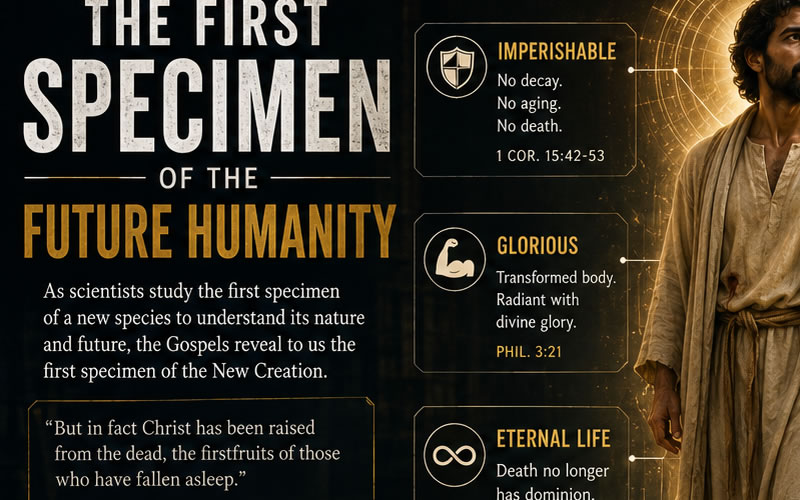
Humanity has always dreamed of a better future. We want to live longer, overcome disease, become more intelligent, and escape the limitations of our bodies. Today, advances in artificial intelligence, biotechnology, and genetic engineering are bringing some of these ambitions closer to reality. What once belonged to science fiction is increasingly becoming a serious area of scientific research. However, if we could upgrade the human body, merge with AI, or extend human life, would we have solved humanity’s fundamental problems? We have made extraordinary progress in science and technology, yet war, injustice, hatred, greed, and death remain part of our world. We have developed deadly weapons and invented powerful political systems, but we still struggle with the question of how to use power wisely. What if the future we need is not a better version of the humanity we already know, but an entirely new humanity? Homo Novus is that new humanity. It is a different vision of humanity’s future centred not on humanity’s ability to transcend itself through technology, but on what God has begun through Jesus Christ. What Went Wrong with Humanity? To understand why humanity needs a new beginning, we must first understand what went wrong in the beginning. According to the biblical account, humanity was not an accident or a meaningless product of the universe. God created human beings in his image and entrusted them with a purpose. That purpose is to represent his rule, cultivate the earth, and fill it with life under his authority. Humanity was created for life with God. We were made to reflect God’s character and extend the goodness of his rule throughout creation. But something went wrong. In Genesis 3, Adam and Eve rejected God’s command and chose to determine good and evil on their own terms. Their rebellion fractured the relationship between humanity and its Creator. Sin entered the human story, bringing alienation, corruption, and death. The consequences extended beyond the first couple. Human relationships became marked by blame and conflict. The ground itself came under a curse. Violence spread through the generations, and humanity’s capacity to create and cultivate was increasingly accompanied by its capacity to destroy. The problem was no longer simply a lack of knowledge. Humanity could discover new things, develop new skills, and build new civilizations, yet still misuse its abilities. Knowledge can tell you what is possible, but it cannot, by itself, make you good. Power can increase your ability to act, but it does not guarantee that you will act wisely. Greater intelligence does not automatically produce greater love, humility, or faithfulness. If these fundamental problems remain unresolved, technological advancement may give us more capable human beings but not better human beings. We could become more powerful versions of ourselves, with all our strengths, weaknesses, and human warts and all. It will amplify our ability to unleash evil on a greater scale and dimension. The Bible’s diagnosis of the human condition is that our problem goes beyond upgraded bodies and brains. We need reconciliation with God, freedom from the power of sin, and deliverance from death itself. But how can such a transformation happen? The Beginning of a New Humanity The Christian message offers an answer that is both unexpected and extraordinary. God did not abandon his purpose for humanity. He entered human history through Jesus to begin the work of making all things new. Jesus did not arrive as a technological genius promising to help humanity overcome its limitations. He came announcing the Kingdom of God, calling people to repentance and demonstrating what life under God’s rule looks like. In his life, we see true humanity in action. Jesus lived in perfect faithfulness to the Father. He loved without selfishness, exercised authority without corruption, and served rather than exploited others. He revealed what human life looks like when it is fully lived in relationship with God. He came to deal with the problem that had corrupted humanity from the beginning. Through his death, he confronted sin. Through his resurrection, he broke the power of death and inaugurated a new future for humanity. The apostle Paul describes Jesus as the “last Adam” and contrasts the humanity represented by Adam with the new humanity represented by Christ (1 Corinthians 15:45–49). Adam’s story leads to sin and death. Christ’s resurrection opens the way to righteousness and life. Paul also calls Christ “the firstfruits of those who have fallen asleep” (1 Corinthians 15:20). Firstfruits are the beginning of a harvest that is still to come. Jesus’ resurrection is the beginning of the future God intends for those who belong to him. He is the first specimen of the future humanity we are called to become. The Christian hope is not that humanity will eventually discover how to defeat death through its own ingenuity. It is that God has acted in history through Jesus Christ and will finally overcome death through him. Jesus’ resurrection is the decisive beginning of what God will one day bring to completion. So, What Is Homo Novus? Homo Novus comes from two Latin words: homo, meaning “human” or “human being,” and novus, meaning “new.” Together, they mean “new human.” In this context, Homo Novus represents the new humanity God is bringing into being through Jesus Christ. It is not a new biological species engineered in a laboratory. It is not a superior class of people who have gained an advantage over others through technology. It is a renewed humanity born through the transforming work of God’s Spirit. Through Christ, God is reconciling people to himself and forming a people whose lives reflect the character and purposes of his Kingdom. The transformation begins now, as people turn to Christ, receive new life, and learn to live under his rule. It will reach its fullness when Christ returns. Those who belong to him will be raised from the dead with glorified bodies that will never perish or die again, and all creation is renewed. Paul expresses this present reality in 2 Corinthians 5:17:
What Is Homo Novus? God’s Answer to Humanity’s Search for a New Future Read More »