Humanity is racing to upgrade itself through artificial intelligence, biotechnology, and genetic engineering. But is Homo sapiens in its current form the final chapter of the human story? The Bible reveals a future far greater than anything technology can achieve. It is a new humanity in Jesus Christ.
The Human Species Is Approaching a Turning Point
For thousands of years, human beings have occupied the centre stage of life on Earth. In scientific terms, we belong to a species known as Homo sapiens. The name scientists use for modern humans, including you and me. We have built civilizations, explored the oceans, travelled into space and developed technologies that our ancestors could scarcely have imagined.
We have conquered diseases that once wiped out entire populations, connected distant parts of the world through the internet and created machines capable of performing tasks that previously required human intelligence. Yet something remarkable is happening. The very species that has dominated the planet is beginning to question its own future.
Artificial intelligence is advancing at an extraordinary pace. Biotechnology is opening possibilities for altering the human body at the genetic level. Scientists are exploring ways to slow ageing, extend healthy lifespans, overcome some of the biological limitations that have defined human existence, and potentially achieve immortality. These developments are not simply technological stories. They are forcing us to reconsider what it means to be human.
What happens when machines can perform tasks that once distinguished human intelligence? What happens when genetic engineering gives us greater control over the characteristics of future generations? What happens when biotechnology begins to challenge the limitations of ageing and disease? And perhaps the most important question of all: Is Homo sapiens the final chapter of humanity’s story?
I believe the answer is no.
In fact, Homo sapiens, as we know it today, is an endangered species. Not necessarily because artificial intelligence or genetic engineering will make us extinct, but because the Bible reveals that our present human condition is not God’s final intention for humanity.
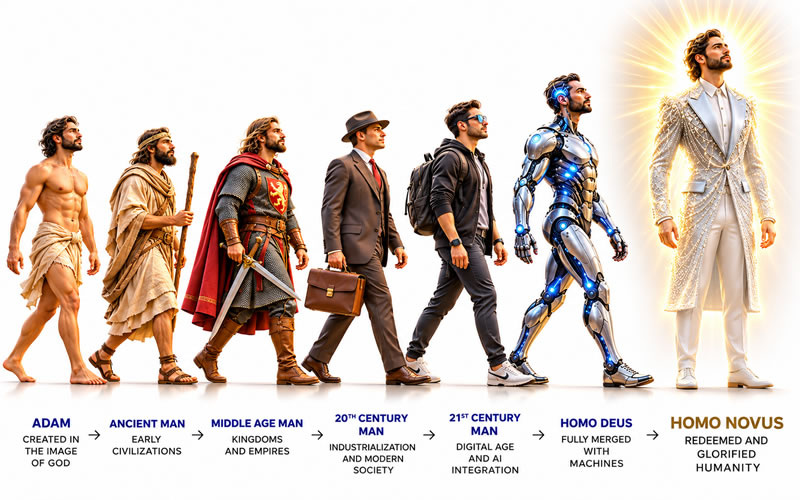
There is another humanity coming. I call it Homo Novus. It comes from two Latin words: homo (human) and novus (new). Together, they mean “new human” or “new humanity.” In this context, Homo Novus represents the new humanity God is bringing into being through Jesus Christ.
Homo Deus is Humanity’s Attempt to Upgrade Itself
For most of human history, we have accepted certain limitations as unavoidable. We are born, we grow old, we become weak, we get sick, and eventually we die.
But modern technology is beginning to challenge some of these assumptions. Artificial intelligence promises to expand our intellectual capabilities. Genetic engineering could help eliminate certain inherited diseases. Biotechnology may eventually offer ways to slow some aspects of ageing. Brain-computer interfaces are opening new possibilities for connecting the human brain with machines.
These developments are part of a much larger ambition to move beyond the limitations of ordinary human existence.
Historian and author Yuval Noah Harari popularised this ambition in his book Homo Deus. He explores a future in which humanity uses technology to pursue godlike powers, including overcoming death, achieving happiness, and gaining unprecedented control over life. The underlying ambition is not difficult to understand. Who wouldn’t want to live longer, stay healthy, become more intelligent, or escape the suffering of human existence? These possibilities are attractive because they speak to desires that have always existed within us.
But there is a more consequential question we must ask. Even if we become healthier, more intelligent, and technologically advanced, will we have overcome the limitations and challenges that define the human condition? Will artificial intelligence and genetic engineering remove greed, hatred, jealousy, selfishness, and corruption from our nature?
Technology may improve many aspects of human existence, but it cannot, by itself, solve the spiritual problem at the heart of humanity. We may eventually become more powerful, but power is not the same as goodness. We may become more intelligent, but intelligence is not the same as wisdom. We may learn to manipulate biological processes, but that is not the same as conquering death.
Imagine humanity living for thousands of years, still consumed by the same sinful desires, but now armed with greater intelligence, power, and technology. Such advances could magnify our capacity for evil and make its consequences far more devastating.
This is where the human ambition represented by Homo Deus or transhuman encounters its greatest limitation.
The Problem With Homo sapiens Is Deeper Than Biology
To understand why Homo sapiens is not humanity’s final destination, we must go back to the beginning. According to Genesis, God created humanity in His image and likeness.
“So God created man in his own image, in the image of God created he him; male and female created he them” (Genesis 1:27).
Human beings were created with dignity, purpose, and the capacity to relate to their Creator. We were entrusted with responsibility over creation and called to reflect God’s character in the world.
But something went terribly wrong. Through disobedience, sin entered the human experience, and with it came death. God had warned Adam that disobedience would bring death (Genesis 2:16–17). Following the fall, humanity became subject to mortality, suffering, corruption, and separation from God. In Romans 5:12, Paul explains it thus:
“Wherefore, as by one man sin entered into the world, and death by sin; and so death passed upon all men, for that all have sinned.”
This is important because it reveals that humanity’s greatest problem is not simply that our bodies are ageing or that our brains have limited processing capacity. Our problem is deeper than biology. We are not just a species that needs better hardware, more computing power, or improved genetic programming. We are a humanity that needs redemption.
Consider the world around you. We have developed extraordinary technologies, yet wars continue. We have more information than previous generations, yet misinformation and deception spread rapidly. We can communicate across continents in seconds, yet loneliness, hatred and division remain widespread. We can send spacecraft beyond our planet, but we still struggle to live peacefully with our neighbours.
The problem is not that human beings lack intelligence or technological ability. It is that something is fundamentally wrong with the human condition. And no amount of technological advancement can, on its own, repair that condition.
This is why God’s answer to humanity is not simply to make Homo sapiens more intelligent, powerful, or biologically advanced. His answer is to create a new humanity.
Homo Novus Is God’s Answer to Humanity’s Future
The future of humanity is not something we must engineer for ourselves, but something God has already revealed and made possible through Jesus Christ. The Bible presents Jesus as more than a religious teacher, prophet, or moral example. He is the beginning of a new humanity.
Paul describes Him as the last Adam. “The first man Adam was made a living soul; the last Adam was made a quickening spirit” (1 Corinthians 15:45).
The first Adam represents the beginning of the present human order, a humanity that became subject to sin and death. Jesus, the last Adam. He inaugurates a new humanity through His death and resurrection. This is the foundation of Homo Novus. It describes humanity renewed in Christ, no longer defined by the fallen condition inherited from Adam, but brought into a new relationship with God through Jesus Christ.
Paul makes this even clearer in 2 Corinthians 5:17: “Therefore if any man be in Christ, he is a new creature: old things are passed away; behold, all things are become new.”
God is not just offering you a better version of your old self. He is inviting you into a new life, a new identity, and a new relationship with Him. This transformation begins now through trust in Christ and the work of the Holy Spirit. The kind of trust that propels you to change the way you live in accordance with His will. But it will reach its fullness in the resurrection.
And this is where the Christian vision of humanity’s future becomes truly extraordinary.
Jesus Is The First Specimen of the Future Humanity
Imagine being shown a prototype of what humanity will eventually become. Not a computer simulation. Not a genetically engineered organism. Not a machine with human intelligence. A real human being, physically raised from the dead, never to die again.
That is what happened when Jesus rose from the dead. His resurrection was a miraculous demonstration that He had conquered death. It was also the first public manifestation of the new humanity God intends to bring into existence.
Paul describes Jesus as “the firstfruits of them that slept” (1 Corinthians 15:20). The word firstfruits is important. In biblical agricultural language, the firstfruits were the first portion of a harvest, indicating that more was to follow.
Jesus’ resurrection was therefore not an isolated event. It was the beginning and guarantee of a much greater harvest, which points to the resurrection of those who belong to Him. Think about the significance of this revolutionary event. Through His resurrection, Jesus demonstrated the future God has prepared for humanity. He is the first specimen of Homo Novus.
And unlike the technological visions of Homo Deus, this new humanity is not produced by upgrading the biological machinery of the old humanity. It is brought into being through the resurrection power of God. Paul explains the difference in 1 Corinthians 15:42–44 (NLT):
“Our earthly bodies are planted in the ground when we die, but they will be raised to live forever. Our bodies are buried in brokenness, but they will be raised in glory. They are buried in weakness, but they will be raised in strength. They are buried as natural human bodies, but they will be raised as spiritual bodies. For just as there are natural bodies, there are also spiritual bodies.”
A spiritual body does not mean an invisible ghost or a person who has ceased to be physical. Jesus Himself demonstrated the reality of bodily resurrection. His disciples could see Him, touch Him, and witness Him eating (Luke 24:36–43). The resurrection body is a transformed body, no longer subject to the corruption, weakness and mortality that characterise our present existence.
This is the future of humanity in Christ.
The End of Homo sapiens as We Know It
When I say Homo sapiens is an endangered species, I am not suggesting that humanity will disappear from existence or that God will replace human beings with an unrelated biological species.
I am saying that Homo sapiens, as we presently experience humanity under the conditions of sin, corruption, and death, is not God’s final expression of what humanity is meant to be. The Bible describes a transition from the old order to the new.
“And as we have borne the image of the earthly, we shall also bear the image of the heavenly” (1 Corinthians 15:49).
In other words, the human story does not end with the image of Adam. Those who belong to Christ will ultimately bear the image of the resurrected Christ. This is not an evolutionary process in which human beings gradually become Homo Novus through natural selection or technological upgrade. It is a divine transformation accomplished through Christ.
The difference is enormous. Homo Deus represents humanity attempting to transcend its limitations through its own knowledge and technological power. Homo Novus represents humanity being transformed through God’s power, beginning with the new birth and reaching its fullness in resurrection. One is an ambition to become more through human achievement. The other is an invitation to become new through God’s redemptive work.
And this future is not reserved for a privileged class of wealthy people who can afford advanced medical procedures or human enhancement technologies. It is God’s promise to those who belong to Christ.
The Coming Kingdom: The Home of Homo Novus
But the story does not end with individual resurrection. God’s ultimate purpose is bigger than rescuing individual human beings from death. He intends to bring about the renewal of creation and establish His Kingdom in its fullness.
The Bible begins with creation in Genesis and ends with a renewed creation in Revelation. John describes a new heaven and a new earth. He hears a voice declaring that God’s dwelling will be with humanity (Revelation 21:1–4). Then comes one of the most beautiful promises in Scripture:
“And God shall wipe away all tears from their eyes; and there shall be no more death, neither sorrow, nor crying, neither shall there be any more pain: for the former things are passed away” (Revelation 21:4).
This is not a promise that we will escape the world and live somewhere else as disembodied spirits. It is the promise of a renewed creation in which death, suffering, and corruption no longer have the final word. The Kingdom of God is the ultimate destination of the new humanity.
Think about a world without funerals, hospitals filled with incurable diseases, broken relationships, oppression, corruption, violence, or the fear of death. Think about human beings living in the fullness of what God intended from the beginning, enjoying fellowship with their Creator and participating in His renewed creation.
That is a future no artificial intelligence system, biotechnology company, or human enhancement programme can deliver. Technology may help us solve many problems, and we should not dismiss legitimate scientific progress. But it cannot bring about the new heaven and new earth. It cannot resurrect the dead or reconcile humanity to God.
Only God can do that. And Jesus Christ is the way into that future.
You Don’t Have to Wait Until the Resurrection to Become Homo Novus
Perhaps the most exciting part of this message is that becoming Homo Novus is not something you must wait until the end of the age to receive. The transformation begins now. When you repent and give your allegiance to Jesus, you become part of God’s new creation. You receive a new identity, a new relationship with God, and a new way of living.
Paul describes this transformation as putting off the old man and putting on the new man, which is created after God in righteousness and true holiness (Ephesians 4:22–24). This means that becoming Homo Novus is not just about anticipating a future resurrection body. It is also about allowing the life of Christ to shape how you live today.
You begin to see people differently. You learn to forgive rather than harbour bitterness. You pursue righteousness rather than selfish ambition. You become more concerned about truth than deception, service than domination, and love than hatred.
You begin to live according to the values of the Kingdom of God rather than allowing the values of a fallen world to define you.
This does not mean you become perfect overnight. It means you have entered a new life and are being transformed into the likeness of Christ. And one day, that transformation will be complete.
You do not need to wait for advanced biotechnology, artificial intelligence, or some future scientific breakthrough to begin this journey. While humanity is looking toward a future it hopes to engineer, God has already revealed a future that human ingenuity cannot manufacture.
Homo sapiens is not the end of the human story. Homo Novus is the future God has promised. The King is coming. His Kingdom is coming. And you are invited to be part of the new humanity that will inherit it.