If someone told you that the first member of humanity’s future race had already appeared on earth, how would you respond?
It sounds like the plot of a science fiction novel. Yet this is precisely what the eyewitness accounts recorded in the Gospels proclaim. The resurrection of Jesus Christ was the public unveiling of a completely new kind of human existence.
Most people think of the resurrection primarily as Jesus’ victory over death. That is certainly true; but the Bible presents something even more astonishing. Jesus did not simply return to life as He had been before. He emerged from the tomb as the first member of a new humanity—a humanity no longer enslaved to sin, decay, disease, or death.
When Humanity Lost Its Way
To understand why the resurrection matters, you must first understand God’s original purpose for humanity. Human beings were created to reflect God’s character and to exercise wise stewardship over His creation (Genesis 1:26). When Adam and Eve chose to rebel against God, something far deeper than disobedience occurred. Humanity’s relationship with its Creator was fractured, and the consequences spread through every part of creation. Suffering and death entered the human story. Fear replaced trust, and selfishness replaced love.
Instead of reflecting God’s character, humanity increasingly reflected its own brokenness. This explains why human history is filled with both breathtaking achievements and heartbreaking failures. We discover cures for diseases and, at the same time, invent weapons capable of destroying millions. We explore distant galaxies and yet struggle to love our neighbors. Our intelligence has grown remarkably, but our moral character has not kept pace.
The problem is that intelligence alone cannot heal a broken heart. That is why every attempt to create a perfect society has ultimately fallen short. Education cannot eliminate selfishness. Wealth cannot remove greed. Political systems cannot erase pride. Technology cannot cure sin. Humanity needs renewal.
God’s Promise of a New Humanity
From the moment humanity fell, God began revealing a remarkable promise. He would not abandon His creation. He would restore it. God intended to bring forth a New Creation. The Apostle Paul later described this beautifully:
“If anyone is in Christ, the new creation has come: The old has gone, the new is here!” (2 Corinthians 5:17).
This is where the Biblical story differs dramatically from every purely human vision of the future.
Humanity dreams of improving itself. God promises to recreate humanity altogether. The Latin expression Homo Novus (the New Human) captures the Bible’s vision of a redeemed humanity. God does not improve fallen human nature through technology. He offers something far more beautiful and revolutionary. He recreates it and offers it as a gift to those who recognize their own moral bankruptcy and acknowledge their need for Him.
The Resurrection and the Birth of Homo Novus
When Jesus rose from the dead on the third day, something happened that had never happened before in human history.
At first glance, it might seem that Jesus was simply another person brought back to life. After all, the Bible records several people who were raised from the dead before Him. But there is one crucial difference. They all died again. Jesus did not.
His resurrection was not a return to ordinary human life. It marked the beginning of a completely new era in human existence. Death no longer had any claim over Him. As Paul writes, “Christ, being raised from the dead, will never die again; death no longer has dominion over Him” (Romans 6:9).
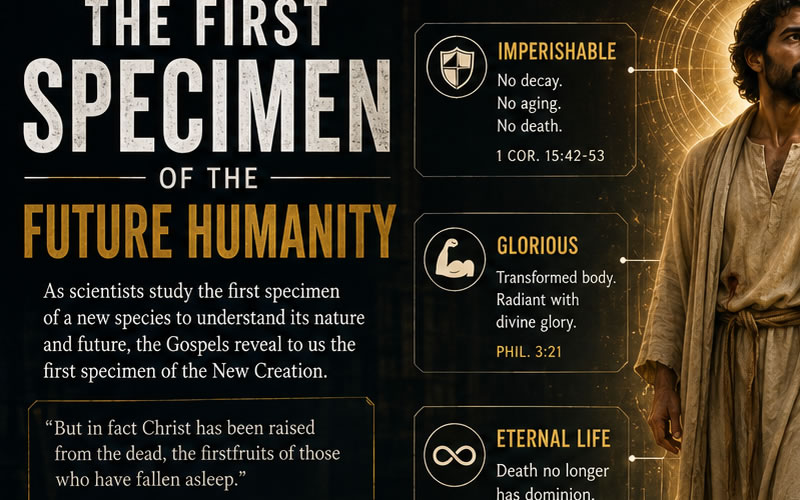
Paul describes Jesus as “the firstfruits of those who have fallen asleep” (1 Corinthians 15:20). The word firstfruits is rich in meaning. In ancient Israel, the firstfruits were the first part of the harvest offered to God. They were not different from the rest of the harvest. They were the first evidence that the full harvest was on its way.
Paul deliberately chose this image.
Jesus is the firstfruits because His resurrection guarantees that others will follow. What happened to Him is what God intends to happen to all who belong to Him. Jesus is indeed the first specimen of the future humanity. He is the firstborn from the dead.
Imagine that scientists discovered the first specimen of an entirely new species. They would examine it carefully because it would reveal the defining characteristics of every member of that species. In much the same way, the risen Jesus is God’s first public demonstration of Homo Novus. When you study the risen Jesus, you will begin to see your own future if you belong to Him.
Studying the First Specimen
The Gospels devote considerable attention to Jesus’ life after the resurrection, and for good reason. They show us what the future humanity looks like.
For forty days after His resurrection, history witnessed something entirely unprecedented. A human being who permanently belonged to the future age walked among ordinary people living in the present age.
Jesus was not a ghost or a disembodied spirit. He could be seen, touched, and heard. He ate fish with His disciples (Luke 24:42–43), prepared breakfast for them by the Sea of Galilee (John 21:9–13), taught them about the Kingdom of God (Acts 1:3), and invited Thomas to place his hand in His wounded side (John 20:27). Every encounter confirmed that He had truly risen in a real, physical body.
Yet His body also displayed remarkable qualities that went beyond anything we experience today. He appeared among His disciples even though the doors were locked (John 20:19), disappeared from the sight of the two disciples at Emmaus (Luke 24:31), and later ascended into heaven before their eyes (Acts 1:9).
The Bible does not explain how these things were possible. It simply records them as eyewitness testimony. The resurrection was clearly the first public demonstration of the New Creation.
A Glimpse Into the Future
One of the most fascinating aspects of the resurrection is that Jesus remained fully Himself.
His disciples recognized His voice, His compassion, and His scars. His memories remained intact. His love for His friends had not diminished. The resurrection did not erase His identity. It perfected it.
This is an important difference between Homo Novus and many visions of technological enhancement.
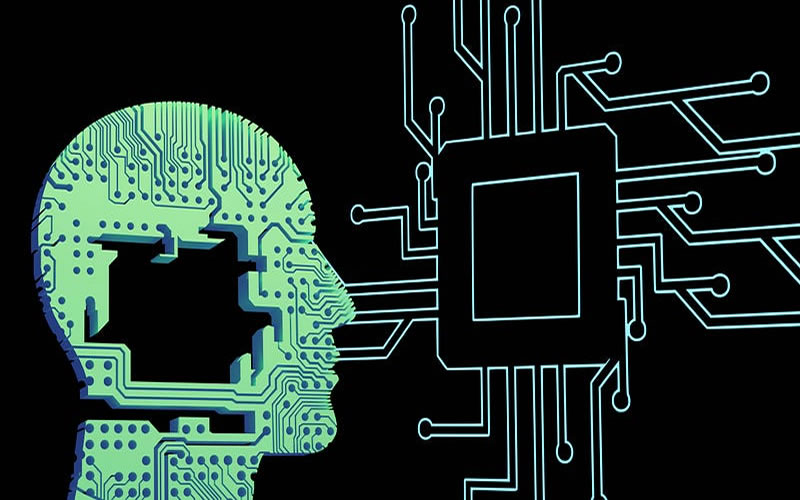
Some transhumanists imagine a future in which humans merge with artificial intelligence, replace biological parts with machines, or even upload consciousness into computers. But such ideas raise difficult questions. If your memories are altered, your emotions programmed, or your decisions increasingly made by algorithms, at what point do you cease to be the person you once were? If a machine determines your choices, who is really exercising your will?
The resurrection points in a very different direction. God does not replace your identity. He restores it. He removes everything that sin has corrupted while preserving everything that reflects His original design for you. You do not become someone else. You finally become the person God always intended you to be.
Paul describes the resurrection body as “imperishable,” “glorious,” and “powerful” (1 Corinthians 15:42–44). This is not simply a healthier version of the human body. It is humanity finally freed from corruption. The resurrection announces that death is not the final chapter of the human story. It is the defeated enemy.
The first victory has already been won. The first specimen already lives. And because He lives, everyone who belongs to Him will one day share in the same glorious life. As John writes with confidence:
“Dear friends, now we are children of God, and what we will be has not yet been made known. But we know that when Christ appears, we shall be like Him, for we shall see Him as He is” (1 John 3:2).
The future humanity is no longer a distant dream. In the risen Christ, it has already appeared.
The Future Begins Today
Although the full transformation into Homo Novus will take place at the first mass resurrection when Jesus returns, the process begins the moment you place your faith in Jesus Christ. The New Testament teaches that God first changes you on the inside before He changes you on the outside. He gives you a new heart, a new Spirit, and a new way of seeing the world. Your body may still be subject to weakness and death, but your life has already become part of God’s New Creation.
This is why Paul declares, “If anyone is in Christ, he is a new creation” (2 Corinthians 5:17). The work has already begun, even though it has not yet reached its completion. The New Testament often speaks of believers as people living between two worlds. You still live in the old creation, but you already belong to the new one. You now live in anticipation of the day when Christ “will transform our lowly bodies so that they will be like His glorious body” (Philippians 3:21).
This means the Christian life is far more than preparing for heaven after death. It is training for the life of the age to come. Every act of love, every step of obedience, every victory over sin, every sacrifice for God’s Kingdom, and every work of faith is shaping you into the person you will one day become. The Holy Spirit is already forming the character of Homo Novus within you while you await the complete transformation of your body.
Why This Changes Everything
If the resurrection of Jesus is true, then it changes everything. It means death is no longer humanity’s greatest certainty. It means the grave is no longer the end of our story. It means the future is not ultimately determined by biology, technology, politics, economics, or even the slow decay of the universe. It is determined by the God who raised Jesus from the dead.
This is why the resurrection offers a hope that no technological breakthrough can match. Science may one day help people live longer. It may cure diseases that once seemed incurable. It may produce astonishing advances in artificial intelligence, medicine, and biotechnology. These are remarkable achievements, and they should be welcomed when they are used wisely to serve humanity.
But no technology can erase sin and guilt. No algorithm can teach perfect love. No genetic engineering can produce righteousness. No machine can reconcile you to your Creator. No scientific breakthrough can guarantee victory over death itself.
Only the resurrection of Jesus offers all of these.
The Christian hope is not that humanity will one day become clever enough to save itself. The Christian hope is that God has already acted in history through Jesus Christ to accomplish what humanity could never accomplish on its own.
History has already witnessed the first specimen of the future humanity. His name is Jesus Christ. The empty tomb was the beginning of God’s new human race. The resurrection was the first glimpse of a world where sin is gone, death is defeated, creation is renewed, and humanity finally becomes everything God intended it to be.
The only question that remains is this:
Will you remain part of the old humanity in Adam (Homo Sapiens), pursuing the dream of Homo Deus, or will you become part of the new humanity in Christ (Homo Novus)? The choice is entirely yours.