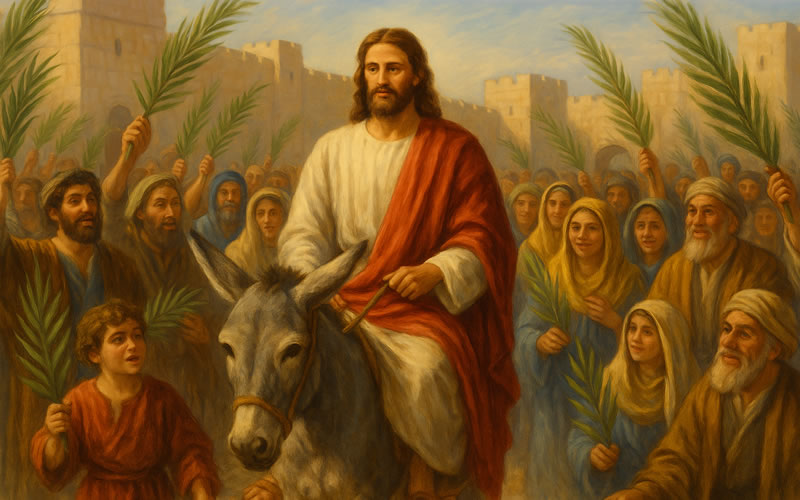
On this day, we remember Jesus’ triumphal entry into Jerusalem. It was an event loaded with prophetic fulfillment, and future promise. People waved palm branches and shouted “Hosanna!” to welcome Jesus, but there was a deeper meaning behind it. It pointed to His future return as the true King who will rule the nations from Jerusalem.
The Cultural and Historical Context
To truly grasp the magnitude of what happened on that first Palm Sunday, we need to understand the cultural backdrop. In ancient times, when a Roman emperor or victorious general arrived at a city, citizens would go outside the city to meet him and escort him back in triumph. This concept is known as Roman Triumph. A Roman triumph was a highly ceremonial parade accorded to victorious generals returning from war. These grand processions would include the general himself in a chariot drawn by horses, wearing a laurel crown, and hailed as a hero by the masses. The final destination is usually the Temple of Jupiter, where they sacrifice to their gods.
But Jesus’ triumphal entry stood in stark contrast. He did not ride a chariot but chose a donkey on purpose. This fulfilled the prophecy in Zechariah 9:9 that the Messiah would come in humility. He entered Jerusalem not to conquer nations by force but to conquer sin through sacrifice.
The Triumphal Entry to Jerusalem
The Triumphal Entry started in Bethphage (a small village on the Mount of Olives) outside Jerusalem and ended up in the Temple inside the city. Jesus entered the city of Jerusalem through one of its gates, likely the Golden Gate. He then proceeded straight to the Temple to cleanse it by driving out the merchants and money changers, whom He condemned as robbers for turning the Temple into a place of exploitation.
The whole city was stirred with excitement. The growing excitement wasn’t limited to His disciples. It spread to the pilgrims and residents who had gathered for the annual feast of Passover. Many of them were asking, “Who is this?”. This was a public, spontaneous celebration that recognized something divine and kingly in Jesus’ arrival. The crowds that followed Jesus during the procession cried out, saying:
“Hosanna to the Son of David! ‘Blessed is He who comes in the name of the Lord!’ Hosanna in the highest!” (Matthew 21:9)
The word Hosanna comes from a Hebrew phrase. It means “save us” or “save now.” Over time, it also became an expression of praise, something like “salvation is here!” The title Son of David acknowledges Jesus as the promised descendant of King David, whose kingdom God said would never end. By calling Him the “Son of David,” the people were essentially declaring that Jesus was the long-awaited Messiah, the rightful King of Israel.
Similarly, the expression “Blessed is he who comes in the name of the Lord!” is taken from Psalm 118:26, a psalm traditionally sung during the Jewish festival of Passover. It was a song of deliverance and celebration for the coming of God’s chosen one. By applying it to Jesus, the crowd acknowledged that He was sent by God, carrying divine authority.
“Hosanna in the highest!“ is a way of saying, “Glory to God in the highest as He sends us salvation!” It’s both a prayer and a praise. It was obvious many of them expected a political liberator that would save them from the Romans. Jesus did come to save, but first He must save them from their sins through the cross, before returning to save them from the Romans through the sword.
A Glimpse of the Future: From Suffering Servant to Reigning King
Jesus’ return will mirror His Triumphal Entry on Palm Sunday, yet it will be in a much grander and more permanent sense. While Jesus’ first coming was marked by humility, His second coming will be marked by glory. Revelation 19 describes a different kind of triumph: Jesus riding a white horse, leading the armies of heaven. His followers will rise to meet Him in the sky to welcome him (Thessalonians 4:16-17), before He proceeds to the Mount of Olives in Jerusalem. Paul may have drawn on the imagery of a Roman triumph to illustrate how believers will rise to meet and welcome Christ in the sky, and then return with Him to share in His reign. During this time, the Wedding Feast of the Lamb, also known as the Great Messianic Banquet will take place. It marks the glorious union of Christ with His people.
Jesus will enter Jerusalem in power and glory, not as a suffering servant like in His first coming, but as the conquering King and Judge. This time, He will confront and overthrow the Roman impostor king, or what many refer to as the Antichrist. He will rule from Jerusalem, just as the prophets said long ago. Zechariah 14 says that His feet will stand again on the Mount of Olives. This is the same place where He entered Jerusalem on Palm Sunday and later went up into heaven. It is believed that Jesus will enter the rebuilt Third Temple, cleanse it as He did before, and take His place there as the rightful King forever (Ezekiel 43:4-5).
Are You Ready for His Return?
Palm Sunday reminds us that we live between two triumphs. One has already happened, and the other is still to come. Most of the people who cheered for Him on Palm Sunday later joined in calling for His crucifixion. They did not understand His true mission and purpose. This should serve as a lesson for us today. It is possible to wave palm branches and still fail to recognize Him as your Lord and King. We are not only to commemorate Palm Sunday but to live in anticipation of His return. The signs of the times, and the unfolding of prophecy all point to the nearness of that glorious day.
Are you ready for His return? The first triumphal entry on a donkey was marked by humility and peace, and was largely ignored by many. The next, however, will be impossible to ignore. Jesus will return, not on a donkey, but on a white horse. Not in humility, but in majesty. The white horse signifies His role as the conquering King who will bring ultimate justice and judgment. And He will rule the nations from Jerusalem, as the King of kings and Lord of lords. This Palm Sunday, celebrate the King who came, and prepare for the King who is coming again.