Homo Novus

Homo Sapiens is an Endangered Species

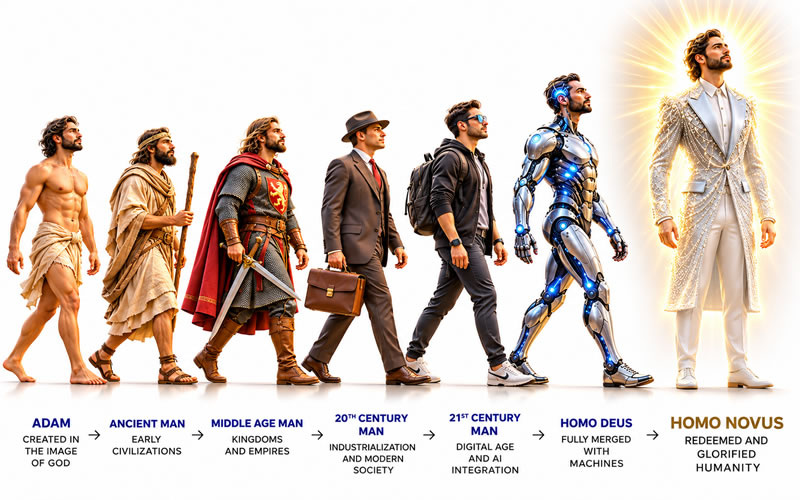
Humanity is racing to upgrade itself through artificial intelligence, biotechnology, and genetic engineering. But is Homo sapiens in its current form the final chapter of the human story? The Bible reveals a future far greater than anything technology can achieve. It is a new humanity in Jesus Christ. The Human Species Is Approaching a Turning Point For thousands of years, human beings have occupied the centre stage of life on Earth. In scientific terms, we belong to a species known as Homo sapiens. The name scientists use for modern humans, including you and me. We have built civilizations, explored the oceans, travelled into space and developed technologies that our ancestors could scarcely have imagined. We have conquered diseases that once wiped out entire populations, connected distant parts of the world through the internet and created machines capable of performing tasks that previously required human intelligence. Yet something remarkable is happening. The very species that has dominated the planet is beginning to question its own future. Artificial intelligence is advancing at an extraordinary pace. Biotechnology is opening possibilities for altering the human body at the genetic level. Scientists are exploring ways to slow ageing, extend healthy lifespans, overcome some of the biological limitations that have defined human existence, and potentially achieve immortality. These developments are not simply technological stories. They are forcing us to reconsider what it means to be human. What happens when machines can perform tasks that once distinguished human intelligence? What happens when genetic engineering gives us greater control over the characteristics of future generations? What happens when biotechnology begins to challenge the limitations of ageing and disease? And perhaps the most important question of all: Is Homo sapiens the final chapter of humanity’s story? I believe the answer is no. In fact, Homo sapiens, as we know it today, is an endangered species. Not necessarily because artificial intelligence or genetic engineering will make us extinct, but because the Bible reveals that our present human condition is not God’s final intention for humanity. There is another humanity coming. I call it Homo Novus. It comes from two Latin words: homo (human) and novus (new). Together, they mean “new human” or “new humanity.” In this context, Homo Novus represents the new humanity God is bringing into being through Jesus Christ. Homo Deus is Humanity’s Attempt to Upgrade Itself For most of human history, we have accepted certain limitations as unavoidable. We are born, we grow old, we become weak, we get sick, and eventually we die. But modern technology is beginning to challenge some of these assumptions. Artificial intelligence promises to expand our intellectual capabilities. Genetic engineering could help eliminate certain inherited diseases. Biotechnology may eventually offer ways to slow some aspects of ageing. Brain-computer interfaces are opening new possibilities for connecting the human brain with machines. These developments are part of a much larger ambition to move beyond the limitations of ordinary human existence. Historian and author Yuval Noah Harari popularised this ambition in his book Homo Deus. He explores a future in which humanity uses technology to pursue godlike powers, including overcoming death, achieving happiness, and gaining unprecedented control over life. The underlying ambition is not difficult to understand. Who wouldn’t want to live longer, stay healthy, become more intelligent, or escape the suffering of human existence? These possibilities are attractive because they speak to desires that have always existed within us. But there is a more consequential question we must ask. Even if we become healthier, more intelligent, and technologically advanced, will we have overcome the limitations and challenges that define the human condition? Will artificial intelligence and genetic engineering remove greed, hatred, jealousy, selfishness, and corruption from our nature? Technology may improve many aspects of human existence, but it cannot, by itself, solve the spiritual problem at the heart of humanity. We may eventually become more powerful, but power is not the same as goodness. We may become more intelligent, but intelligence is not the same as wisdom. We may learn to manipulate biological processes, but that is not the same as conquering death. Imagine humanity living for thousands of years, still consumed by the same sinful desires, but now armed with greater intelligence, power, and technology. Such advances could magnify our capacity for evil and make its consequences far more devastating. This is where the human ambition represented by Homo Deus or transhuman encounters its greatest limitation. The Problem With Homo sapiens Is Deeper Than Biology To understand why Homo sapiens is not humanity’s final destination, we must go back to the beginning. According to Genesis, God created humanity in His image and likeness. “So God created man in his own image, in the image of God created he him; male and female created he them” (Genesis 1:27). Human beings were created with dignity, purpose, and the capacity to relate to their Creator. We were entrusted with responsibility over creation and called to reflect God’s character in the world. But something went terribly wrong. Through disobedience, sin entered the human experience, and with it came death. God had warned Adam that disobedience would bring death (Genesis 2:16–17). Following the fall, humanity became subject to mortality, suffering, corruption, and separation from God. In Romans 5:12, Paul explains it thus: “Wherefore, as by one man sin entered into the world, and death by sin; and so death passed upon all men, for that all have sinned.” This is important because it reveals that humanity’s greatest problem is not simply that our bodies are ageing or that our brains have limited processing capacity. Our problem is deeper than biology. We are not just a species that needs better hardware, more computing power, or improved genetic programming. We are a humanity that needs redemption. Consider the world around you. We have developed extraordinary technologies, yet wars continue. We have more information than previous generations, yet misinformation and deception spread rapidly. We can communicate across continents in seconds, yet loneliness, hatred and division remain widespread. We can send

Homo Sapiens is an Endangered Species Read More »

What Is Homo Novus? God’s Answer to Humanity’s Search for a New Future

Humanity has always dreamed of a better future. We want to live longer, overcome disease, become more intelligent, and escape the limitations of our bodies. Today, advances in artificial intelligence, biotechnology, and genetic engineering are bringing some of these ambitions closer to reality. What once belonged to science fiction is increasingly becoming a serious area of scientific research. However, if we could upgrade the human body, merge with AI, or extend human life, would we have solved humanity’s fundamental problems? We have made extraordinary progress in science and technology, yet war, injustice, hatred, greed, and death remain part of our world. We have developed deadly weapons and invented powerful political systems, but we still struggle with the question of how to use power wisely.  What if the future we need is not a better version of the humanity we already know, but an entirely new humanity? Homo Novus is that new humanity. It is a different vision of humanity’s future centred not on humanity’s ability to transcend itself through technology, but on what God has begun through Jesus Christ. What Went Wrong with Humanity? To understand why humanity needs a new beginning, we must first understand what went wrong in the beginning. According to the biblical account, humanity was not an accident or a meaningless product of the universe. God created human beings in his image and entrusted them with a purpose. That purpose is to represent his rule, cultivate the earth, and fill it with life under his authority. Humanity was created for life with God. We were made to reflect God’s character and extend the goodness of his rule throughout creation. But something went wrong. In Genesis 3, Adam and Eve rejected God’s command and chose to determine good and evil on their own terms. Their rebellion fractured the relationship between humanity and its Creator. Sin entered the human story, bringing alienation, corruption, and death. The consequences extended beyond the first couple. Human relationships became marked by blame and conflict. The ground itself came under a curse. Violence spread through the generations, and humanity’s capacity to create and cultivate was increasingly accompanied by its capacity to destroy. The problem was no longer simply a lack of knowledge. Humanity could discover new things, develop new skills, and build new civilizations, yet still misuse its abilities. Knowledge can tell you what is possible, but it cannot, by itself, make you good. Power can increase your ability to act, but it does not guarantee that you will act wisely. Greater intelligence does not automatically produce greater love, humility, or faithfulness. If these fundamental problems remain unresolved, technological advancement may give us more capable human beings but not better human beings. We could become more powerful versions of ourselves, with all our strengths, weaknesses, and human warts and all. It will amplify our ability to unleash evil on a greater scale and dimension. The Bible’s diagnosis of the human condition is that our problem goes beyond upgraded bodies and brains. We need reconciliation with God, freedom from the power of sin, and deliverance from death itself. But how can such a transformation happen? The Beginning of a New Humanity The Christian message offers an answer that is both unexpected and extraordinary. God did not abandon his purpose for humanity. He entered human history through Jesus to begin the work of making all things new. Jesus did not arrive as a technological genius promising to help humanity overcome its limitations. He came announcing the Kingdom of God, calling people to repentance and demonstrating what life under God’s rule looks like. In his life, we see true humanity in action. Jesus lived in perfect faithfulness to the Father. He loved without selfishness, exercised authority without corruption, and served rather than exploited others. He revealed what human life looks like when it is fully lived in relationship with God. He came to deal with the problem that had corrupted humanity from the beginning. Through his death, he confronted sin. Through his resurrection, he broke the power of death and inaugurated a new future for humanity. The apostle Paul describes Jesus as the “last Adam” and contrasts the humanity represented by Adam with the new humanity represented by Christ (1 Corinthians 15:45–49). Adam’s story leads to sin and death. Christ’s resurrection opens the way to righteousness and life. Paul also calls Christ “the firstfruits of those who have fallen asleep” (1 Corinthians 15:20). Firstfruits are the beginning of a harvest that is still to come. Jesus’ resurrection is the beginning of the future God intends for those who belong to him. He is the first specimen of the future humanity we are called to become. The Christian hope is not that humanity will eventually discover how to defeat death through its own ingenuity. It is that God has acted in history through Jesus Christ and will finally overcome death through him. Jesus’ resurrection is the decisive beginning of what God will one day bring to completion.  So, What Is Homo Novus? Homo Novus comes from two Latin words: homo, meaning “human” or “human being,” and novus, meaning “new.” Together, they mean “new human.” In this context, Homo Novus represents the new humanity God is bringing into being through Jesus Christ. It is not a new biological species engineered in a laboratory. It is not a superior class of people who have gained an advantage over others through technology. It is a renewed humanity born through the transforming work of God’s Spirit.  Through Christ, God is reconciling people to himself and forming a people whose lives reflect the character and purposes of his Kingdom. The transformation begins now, as people turn to Christ, receive new life, and learn to live under his rule. It will reach its fullness when Christ returns. Those who belong to him will be raised from the dead with glorified bodies that will never perish or die again, and all creation is renewed. Paul expresses this present reality in 2 Corinthians 5:17:

What Is Homo Novus? God’s Answer to Humanity’s Search for a New Future Read More »

What Is Homo Deus? Understanding Humanity’s Quest to Become More Than Human

Artificial intelligence can now perform tasks that once required human intelligence. Scientists are exploring ways to edit genes, treat diseases, and extend human life. Researchers are also developing technologies that could change how we interact with computers and, potentially, how our brains and bodies function.  These technologies are improving our lives in remarkable ways, but it is also opening the door to a future where we may no longer be satisfied with being human as we are today. Modern technology is redesigning what it means to be human. But what happens when humanity begins to believe that it can overcome its own limitations and determine its own future? Does becoming more powerful make us better human beings? What Does Homo Deus Mean? Homo Deus is a Latin expression commonly translated as “god-man” or “human god.” In his book, Homo Deus: A Brief History of Tomorrow, Yuval Noah Harari uses the term to explore a possible future in which human beings use science and technology to acquire abilities that have traditionally been associated with gods. The idea is not that humans will literally become the all-powerful Creator described in the Bible. Rather, Harari examines how advances in biotechnology, AI, and other technologies could give people unprecedented control over life, their bodies, and their environment. Consider what humanity has already achieved. We can transplant organs, edit certain genes, communicate across continents instantly, and use machines to perform tasks that once demanded years of human training. These achievements would have seemed extraordinary to earlier generations. Now imagine what might become possible if these technologies advance much further. Could we significantly extend human life? Could we redesign aspects of our biology? Could intelligent machines become smarter than us and make decisions more effectively than we can?  How Does Humanity Hope to Become More Than Human? The idea of evolving beyond our current human limitations is driven by advances in several areas of technology. Although these fields are different, they share a common goal. They aim to expand human abilities and overcome limitations that have long defined our lives. 1. Artificial Intelligence Artificial intelligence is changing how we work, communicate, learn, and make decisions. AI systems can analyse enormous quantities of information, recognise patterns and perform tasks that previously required considerable human effort. As machines become more intelligent than humans and outperform us in more areas, some experts and futurists propose merging human intelligence with AI to enhance our abilities and keep pace with machines. This raises questions about identity, freedom, human control, and decision-making. And what happens when people begin to trust algorithmic decisions more than their own judgement? 2. Biotechnology and Genetic Engineering Biotechnology is giving scientists new ways to understand and influence living organisms. Gene-editing technologies, for example, offer possibilities for treating certain genetic diseases and advancing medical research. Some researchers and futurists imagine going further by using genetic engineering and other biological interventions to enhance human abilities and create designer babies and superhumans. The possibilities raise difficult questions. If we gain greater control over human biology, who should decide which characteristics are desirable? Should we attempt to eliminate particular weaknesses, or could the pursuit of biological perfection create new forms of discrimination? The ability to modify aspects of life brings enormous responsibilities. Not every change we can make is necessarily a change we should make. 3. The Pursuit of Longer Life We all want to live longer and avoid suffering. Modern medicine has helped us survive diseases and conditions that once caused widespread premature death. Longevity research seeks to understand ageing and find ways to extend healthy life. Some researchers and technology advocates envision much more radical breakthroughs that could significantly extend the human lifespan. In fact, several high-profile companies and ventures are backed by billionaires whose stated personal philosophies are explicitly about defeating death and achieving indefinite lifespans.  But there is an important distinction between extending life and overcoming death. Even substantial advances in longevity would not, by themselves, establish that humanity can achieve immortality. Nevertheless, the desire to defeat death remains one of the most striking ambitions associated with the Homo Deus vision. Why Does Humanity Want to Transcend Its Limitations? Humanity’s desire to overcome the human condition is nothing new. We have developed medicines to fight disease, tools to overcome physical weakness and technologies to travel farther and communicate faster. Much of this progress has improved human life. There is nothing inherently wrong with seeking cures for diseases, reducing suffering or developing technologies that help people. But can these achievements really fulfil our ultimate aspirations as humans? We want to live longer because death takes away people we love and brings our own lives to an end. We want greater control because uncertainty makes us uncomfortable. We pursue knowledge because we want to understand the world and influence what happens to us. Technology can solve many of our problems and make life easier. But will it make us truly happy and fulfilled? Even if we live longer, become wealthier, and achieve things that once seemed impossible, we may still struggle with greed, jealousy, loneliness, and the search for meaning. In other words, making life better on the outside does not necessarily resolve the problems we face within ourselves.  What Happens to Humanity If We Merge with Machines and Become Homo Deus? The pursuit of god-like capabilities raises legitimate concerns. The problem isn’t necessarily technological advancement itself, but the assumption that greater power will inevitably lead to a utopia and a better future.  What happens when technology moves beyond being something we use and becomes something integrated into our bodies and brains? If we begin merging with machines, modifying our biology and enhancing our mental and physical abilities, we may eventually change not only how we live, but also what it means to be human. If we increasingly depend on machines to think, remember, communicate, and make decisions, where do we draw the line between human ability and machine capability? At what point might enhancing ourselves begin to

What Is Homo Deus? Understanding Humanity’s Quest to Become More Than Human Read More »

The First Specimen Of The Future Humanity

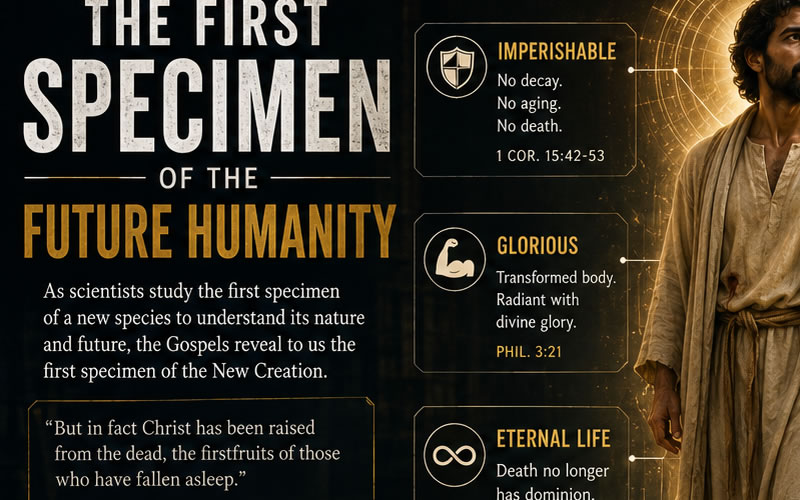
If someone told you that the first member of humanity’s future race had already appeared on earth, how would you respond? It sounds like the plot of a science fiction novel. Yet this is precisely what the eyewitness accounts recorded in the Gospels proclaim. The resurrection of Jesus Christ was the public unveiling of a completely new kind of human existence. Most people think of the resurrection primarily as Jesus’ victory over death. That is certainly true; but the Bible presents something even more astonishing. Jesus did not simply return to life as He had been before. He emerged from the tomb as the first member of a new humanity—a humanity no longer enslaved to sin, decay, disease, or death. When Humanity Lost Its Way  To understand why the resurrection matters, you must first understand God’s original purpose for humanity. Human beings were created to reflect God’s character and to exercise wise stewardship over His creation (Genesis 1:26). When Adam and Eve chose to rebel against God, something far deeper than disobedience occurred. Humanity’s relationship with its Creator was fractured, and the consequences spread through every part of creation. Suffering and death entered the human story. Fear replaced trust, and selfishness replaced love. Instead of reflecting God’s character, humanity increasingly reflected its own brokenness. This explains why human history is filled with both breathtaking achievements and heartbreaking failures. We discover cures for diseases and, at the same time, invent weapons capable of destroying millions. We explore distant galaxies and yet struggle to love our neighbors. Our intelligence has grown remarkably, but our moral character has not kept pace. The problem is that intelligence alone cannot heal a broken heart. That is why every attempt to create a perfect society has ultimately fallen short. Education cannot eliminate selfishness. Wealth cannot remove greed. Political systems cannot erase pride. Technology cannot cure sin. Humanity needs renewal. God’s Promise of a New Humanity  From the moment humanity fell, God began revealing a remarkable promise. He would not abandon His creation. He would restore it. God intended to bring forth a New Creation. The Apostle Paul later described this beautifully: “If anyone is in Christ, the new creation has come: The old has gone, the new is here!” (2 Corinthians 5:17). This is where the Biblical story differs dramatically from every purely human vision of the future. Humanity dreams of improving itself. God promises to recreate humanity altogether. The Latin expression Homo Novus (the New Human) captures the Bible’s vision of a redeemed humanity. God does not improve fallen human nature through technology. He offers something far more beautiful and revolutionary. He recreates it and offers it as a gift to those who recognize their own moral bankruptcy and acknowledge their need for Him. The Resurrection and the Birth of Homo Novus  When Jesus rose from the dead on the third day, something happened that had never happened before in human history. At first glance, it might seem that Jesus was simply another person brought back to life. After all, the Bible records several people who were raised from the dead before Him. But there is one crucial difference. They all died again. Jesus did not. His resurrection was not a return to ordinary human life. It marked the beginning of a completely new era in human existence. Death no longer had any claim over Him. As Paul writes, “Christ, being raised from the dead, will never die again; death no longer has dominion over Him” (Romans 6:9). Paul describes Jesus as “the firstfruits of those who have fallen asleep” (1 Corinthians 15:20). The word firstfruits is rich in meaning. In ancient Israel, the firstfruits were the first part of the harvest offered to God. They were not different from the rest of the harvest. They were the first evidence that the full harvest was on its way. Paul deliberately chose this image. Jesus is the firstfruits because His resurrection guarantees that others will follow. What happened to Him is what God intends to happen to all who belong to Him. Jesus is indeed the first specimen of the future humanity. He is the firstborn from the dead. Imagine that scientists discovered the first specimen of an entirely new species. They would examine it carefully because it would reveal the defining characteristics of every member of that species. In much the same way, the risen Jesus is God’s first public demonstration of Homo Novus. When you study the risen Jesus, you will begin to see your own future if you belong to Him. Studying the First Specimen The Gospels devote considerable attention to Jesus’ life after the resurrection, and for good reason. They show us what the future humanity looks like. For forty days after His resurrection, history witnessed something entirely unprecedented. A human being who permanently belonged to the future age walked among ordinary people living in the present age. Jesus was not a ghost or a disembodied spirit. He could be seen, touched, and heard. He ate fish with His disciples (Luke 24:42–43), prepared breakfast for them by the Sea of Galilee (John 21:9–13), taught them about the Kingdom of God (Acts 1:3), and invited Thomas to place his hand in His wounded side (John 20:27). Every encounter confirmed that He had truly risen in a real, physical body. Yet His body also displayed remarkable qualities that went beyond anything we experience today. He appeared among His disciples even though the doors were locked (John 20:19), disappeared from the sight of the two disciples at Emmaus (Luke 24:31), and later ascended into heaven before their eyes (Acts 1:9). The Bible does not explain how these things were possible. It simply records them as eyewitness testimony. The resurrection was clearly the first public demonstration of the New Creation. A Glimpse Into the Future One of the most fascinating aspects of the resurrection is that Jesus remained fully Himself. His disciples recognized His voice, His compassion, and His scars. His memories remained intact. His love

The First Specimen Of The Future Humanity Read More »

Interview with Frank Viola

I recently had the incredible opportunity to discuss my new book with one of my favorite Christian authors, Frank Viola. Frank Viola is an accomplished Christian blogger, conference speaker, and a Wall Street Journal bestselling author of over 13 books including ‘Insurgence: Reclaiming the Gospel of the Kingdom’. The full interview is published on Frank Viola Patheos Blog

Interview with Frank Viola Read More »

Homo Novus Press Release

A Fascinating Exploration of the Future of Humanity Through a Theistic Lens PORT-HARCOURT, RIVERS, NIGERIA, September 12, 2023/ EINPresswire.com / — In an era where technological advancements are shaping the trajectory of our society, there is growing concern about the potential consequences of this rapid digitalization. Amakiri Welekwe, a technology consultant and evangelist addresses these pressing concerns in his groundbreaking nonfiction book, “Homo Novus: A Brief His-story of Tomorrow.” Drawing on a lifetime of work in information technology and a theistic perspective, Welekwe offers a profound examination of history and presents a compelling vision of humanity’s future…. Full article on Associated Press

Homo Novus Press Release Read More »

Scroll to Top